
The science
Why waterless changes everything.
A fragrance is built in three layers. Most home diffusers destroy the first one before it reaches you. Cold-air atomisation is the reason a hotel lobby smells composed and a plug-in smells like a single note on repeat.
The pyramid
Three layers, three timescales.
A perfumer does not build a smell. They build a sequence — what you meet at the door, what holds the room, and what is still there an hour later.
Top
0 – 30 minutes
Citrus, herbs, green notes. The lightest molecules, the first to evaporate — and the first thing heat destroys.
Heart
30 minutes – 3 hours
Florals, spices, fruit. The body of the composition and what most people would describe if asked what a room smells of.
Base
3 hours onward
Woods, resins, musk, amber. Heavy molecules that hold everything together and stay in soft furnishings.
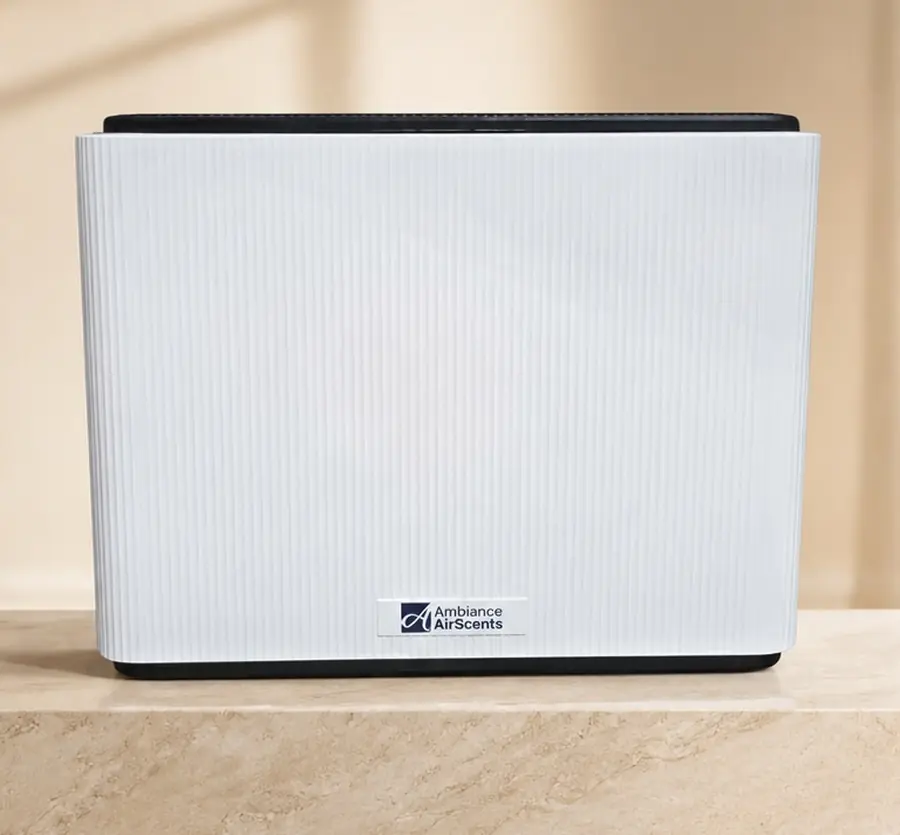
Inside the AromaSphere
Pressure, not heat.
- 01
Compressed air is forced across the oil
A small pump drives air through a nozzle. No element, no water, no solvent — the oil is never warmed and never diluted.
- 02
The oil shears into a nano-mist
The stream breaks the oil into particles fine enough to remain suspended in air rather than falling onto surfaces.
- 03
Only the finest particles leave the chamber
Heavier droplets fall back into the tank and are re-atomised. What exits is uniform, dry and invisible.
- 04
Diffusion is metered on a schedule
Seconds on, minutes off. Continuous diffusion causes nose-blindness; intervals keep a room noticeable to someone walking in.
Compared
The right way to scent a space.
Three methods, the same six questions. The answers are what they are.
What we do
6/6Waterless cold-air
The composition reaches the room as the perfumer built it.
- Heat applied
- None
- Dilution
- None — pure oil
- Particle size
- Nano, stays suspended
- Residue
- None on surfaces
- Coverage
- Up to 3,500 sq ft
- Top notes
- Fully preserved
The alternative
1/6Ultrasonic / water mist
Water carries the oil, and dilutes it on the way.
- Heat applied
- None
- Dilution
- Heavy — water carrier
- Particle size
- Large droplets
- Residue
- Damp film, mineral scale
- Coverage
- One small room
- Top notes
- Muted by dilution
The alternative
0/6Heated / plug-in
Heat changes the fragrance before it reaches the air.
- Heat applied
- Continuous
- Dilution
- Solvent carrier
- Particle size
- Uneven
- Residue
- Oily film near the outlet
- Coverage
- A corner
- Top notes
- Burned off in minutes
Comparison describes the general behaviour of each diffusion method. Individual products vary.
Questions
The practical detail.
Cold-air nano diffusion breaks the fragrance oil into a dry micro-mist without heat or water. Heat degrades top notes and water dilutes them — waterless diffusion delivers the composition the perfumer actually built, and leaves no residue on surfaces.
In a 1,500 sq ft space on a standard schedule, roughly 30 to 45 days. Larger spaces and higher intensity settings shorten that. The same bottle also tops up the car diffuser.
No. Every refill is a one-off order — nothing renews and nothing is charged automatically. Order again whenever you are running low, in any of the seventeen fragrances. If you bought Home & Car, every refill costs $99 instead of $129 for a year, applied by itself when you are signed in.
The diffuser runs cold with no open flame and no heated element. Fragrance oils are concentrated and should be kept sealed and out of reach, and the diffuser should be mounted or placed where it will not be knocked over.
Across the United States.
Smell them first: choose up to six samples and pay only the shipping — the Samples page sends your list to us on WhatsApp. Or let the Scent Finder narrow the seventeen down to one in about forty seconds, using the room, the feeling you want and how present the scent should be.